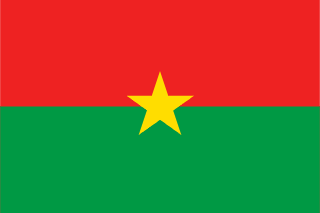
The Mossi kingdoms
Long before France drew Upper Volta on a map, the plateau was ruled by the Mossi kingdoms, founded around the fifteenth century and centred on Ouagadougou under a paramount ruler, the Mogho Naba, whose court still exists as a ceremonial institution today. The Mossi were unusual in the region for resisting Islamisation and for holding off the jihad states and slave raiders around them through a disciplined cavalry and a tight political order.
France conquered the area in the 1890s and created the colony of Upper Volta in 1919, dissolved it in 1932 to farm out its labour to richer neighbours, and reconstituted it in 1947. The name recorded the three Volta rivers — the Black, White and Red — that cross the land.
Sankara's revolution
Independence came on 5 August 1960, followed by two decades of coups and weak civilian governments over one of the world's poorest populations. Then in 1983 Thomas Sankara, 33 and charismatic, took power and launched a crash programme of self-reliance: mass literacy and vaccination drives, land reform, tree-planting against the desert, and a rejection of foreign aid he saw as a leash.
On 4 August 1984, the first anniversary of his revolution, he renamed the country Burkina Faso, fusing Mooré and Dioula words to mean roughly "land of the upright people". He was austere, moralistic and abrasive, and he made enemies at home and in Paris. On 15 October 1987 he was assassinated in a coup led by his closest ally, Blaise Compaoré, who long denied involvement; a Burkinabè court convicted him in absentia of the murder in 2022.
Compaoré and the war
Compaoré ruled for 27 years, a fixture of Françafrique and a regional powerbroker, until a 2014 popular uprising drove him out when he tried to extend his term. Democracy under Roch Marc Christian Kaboré followed — and then the jihadist violence spilling out of Mali overwhelmed it.
By the early 2020s armed groups controlled swathes of the north and east, displacing more than two million people. Two coups in 2022 brought Ibrahim Traoré, an army captain in his mid-thirties, to power. He expelled French troops, turned to Russia, and joined Mali and Niger in leaving ECOWAS to form the Alliance of Sahel States. His anti-Western defiance has made him a hero to many young Africans even as the death toll from the war keeps climbing.
Cinema and the upright land
For a landlocked country routinely ranked among the world's poorest, Burkina Faso carries outsized cultural weight. Ouagadougou hosts FESPACO, the largest African film festival, held since 1969, which every two years turns the capital into the meeting-place of the continent's cinema. Its bronze filmmaker's monument and sprawling craft markets sit at the heart of a self-consciously artistic city.
Sankara's memory still shapes that identity. His insistence on dignity, self-reliance and refusing debt has made him an icon well beyond Burkina Faso, revived by a new generation across the Sahel — and knowingly invoked by Ibrahim Traoré. The economy leans on gold, now the leading export, and on cotton, once billed as "white gold", grown by farmers whose fortunes swing with distant prices and a spreading war.