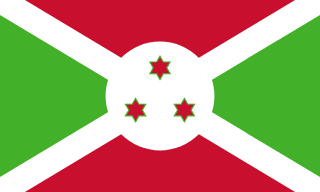
Flag of Burundi

Burundi

East Africa · Republic · Independent 1962

Burundi is the country the world keeps confusing with Rwanda and then forgetting. It has the same hills, the same Hutu–Tutsi–Twa population, the same colonial handling — yet its history ran the other way, with a long-dominant Tutsi military and mass killings of Hutu that the outside world barely registered. In 1972 the army killed somewhere between 100,000 and 200,000 Hutu, one of the least-acknowledged atrocities of the century. Landlocked, overwhelmingly rural and among the poorest nations on earth, it moved its political capital to Gitega in 2019 and remains one of the hardest places in Africa to be a journalist.

CapitalGitega (political); Bujumbura (economic)
Populationc. 13 million
Official languageKirundi, French
Also spokenSwahili, English
CurrencyBurundian franc (BIF)
Independence1 July 1962 (from Belgium)
PresidentÉvariste Ndayishimiye (since 2020)

The kingdom of the drums

Like Rwanda, pre-colonial Burundi was an old, centralised kingdom under a mwami, with Hutu, Tutsi and Twa sharing the Kirundi language and a common culture. Its distinctive institution was the royal drum: the karyenda drums were sacred objects tied to the king's legitimacy, and the ritual drummers of Gishora are now a UNESCO-recognised cultural tradition.

Germany claimed the territory in the 1890s and Belgium took over during the First World War, running Ruanda-Urundi as a single mandate. As next door, the Belgians rigidified ethnic categories and governed through a favoured elite, storing up the divisions that would detonate after independence.

1972: the hidden killing

Burundi became independent on 1 July 1962. Where Rwanda's revolution had put Hutu in charge, Burundi's monarchy and then its republic remained dominated by a Tutsi military elite. In 1972, following a localised Hutu uprising in the south that killed thousands of Tutsi, the Tutsi-led army launched a systematic reprisal against Hutu — targeting the educated in particular, teachers, civil servants, students.

Estimates of the dead range from roughly 100,000 to over 200,000, with hundreds of thousands more fleeing to Tanzania. Scholars have called it a genocide against the Hutu. It was carried out with little international protest and remains far less known than Rwanda's 1994 catastrophe, though it shaped a generation of Burundian politics.

1993 and the long war

A cautious opening led to Burundi's first democratic election in 1993, won by Melchior Ndadaye, the country's first elected Hutu president. Within months, in October 1993, Tutsi soldiers assassinated him. The killing triggered a civil war between Hutu rebel movements and the Tutsi-dominated army that ground on for over a decade and killed an estimated 300,000 people.

The Arusha peace process, mediated in part by Nelson Mandela, eventually brought a power-sharing settlement and a transition. Pierre Nkurunziza, a former rebel leader, became president in 2005. His decision to seek a disputed third term in 2015 set off a fresh crisis: an attempted coup, a crackdown, hundreds killed and hundreds of thousands displaced.

A closed and struggling state

Nkurunziza's government withdrew Burundi from the International Criminal Court in 2017 and squeezed the press and civil society hard. He died suddenly in 2020 — officially of a heart attack, amid the pandemic — and was succeeded by Évariste Ndayishimiye, another figure from the ruling CNDD-FDD.

The Burundi that remains is desperately poor, dependent on subsistence farming and coffee, chronically short of electricity and fuel, and near the bottom of global income tables. Its politics are quieter than in the crisis years but no more open, and much of its recent history is still contested and unmourned.

pre-1900The kingdom of Burundi unites the hills under a mwami and the sacred royal drums.
1890s–1916German, then Belgian, colonial rule as part of Ruanda-Urundi.
1962Burundi becomes independent as a monarchy on 1 July.
1966The monarchy is abolished and a Tutsi-dominated republic proclaimed.
1972The army kills 100,000–200,000 Hutu in mass reprisals; many call it genocide.
1988Fresh ethnic violence in the north kills thousands more.
1993Melchior Ndadaye, the first elected Hutu president, is assassinated; civil war erupts.
1993–2005A civil war between Hutu rebels and the Tutsi army kills around 300,000.
2000The Arusha Accords, mediated by Nelson Mandela, chart a power-sharing peace.
2005Former rebel Pierre Nkurunziza becomes president.
2015Nkurunziza's disputed third term triggers a coup attempt and crackdown.
2019Gitega is confirmed as the political capital, replacing Bujumbura.
2020Nkurunziza dies; Évariste Ndayishimiye succeeds him.

Burundi Bwacu

"Burundi Bwacu" ("Our Burundi") was adopted at independence in 1962. Written in Kirundi by a committee of writers and set to music by Marc Barengayabo, it addresses the country directly as a beloved homeland, praising its people and asking God's blessing on it. Composed for a newly independent monarchy, it survived the abolition of the kingdom and the decades of upheaval that followed.

Full lyrics and translation → — held off-site deliberately. Anthem texts are official state documents in some countries and still in copyright in others, and Ananse would rather link than guess wrong on either.

Words a group led by Jean-Baptiste Ntahokaja. Music Marc Barengayabo. Adopted 1962.

The recording plays through YouTube's own player and belongs to Urumaxi Anthems, who published it — Ananse does not host or restream it. Every anthem in the Atlas is checked against YouTube's own record before embedding, and must carry the country's name in the published title.

What Burundi is known for

Each place links out to a fuller account. Ananse does not photograph these sites itself yet — when it does, the pictures here will be its own.

Burundi on the wire

Live from the Ananse newsroom, refreshed every 30 minutes.

Loading…

← All countries