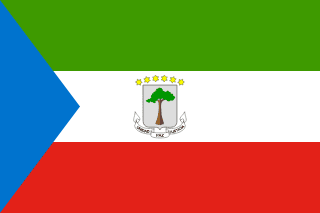
Flag of Equatorial Guinea

Equatorial Guinea

Central Africa · Republic · Independent 1968

Equatorial Guinea is the odd one out: the only country in Africa where Spanish is an official language, a former colony of Madrid rather than Paris or London. Its capital sits not on the mainland but on a volcanic island, Bioko, off the Cameroonian coast. Oil discovered in the 1990s made it, per head, one of the richest countries in Africa — a wealth almost none of its people see, and which has underwritten the rule of Teodoro Obiang, in power since 1979 and now the world's longest-serving head of state.

CapitalMalabo (on Bioko island)
PopulationAbout 1.7 million
Official languagesSpanish, French and Portuguese
Also spokenFang, Bubi and pidgin English
CurrencyCentral African CFA franc (XAF)
Independence12 October 1968 (from Spain)

A Spanish island and a mainland

The country is really two places joined by history: the island of Bioko (long called Fernando Pó), sighted by the Portuguese in the 15th century and later handed to Spain, and Río Muni, a slice of mainland forest between Cameroon and Gabon. The island's Bubi people and the mainland's Fang majority have very different pasts.

Spain ran the territories as its only sub-Saharan colony, importing cocoa plantations to Bioko worked in part by contract labourers from Nigeria and elsewhere. Spanish became the language of administration and church, a legacy that still sets the country apart from every French- and English-speaking neighbour.

Macías and terror

Independence came in 1968 under Francisco Macías Nguema, and it went catastrophically wrong. Macías built one of the most murderous dictatorships of post-colonial Africa: he banned the word "intellectual", closed schools and churches, killed or drove out a large share of the educated population, and styled himself with grandiose titles. A third or more of the population is thought to have fled or died during his rule.

In 1979 his nephew, Teodoro Obiang Nguema, overthrew and executed him. The change of ruler ended the worst of the terror but not the family's grip: Obiang has held power ever since.

The oil decades

For its first two decades independence brought poverty. Then, in the mid-1990s, large offshore oil and gas fields were found. Production made Equatorial Guinea one of the highest per-capita income countries in Africa and drew American oil companies to a state most of the world could not place on a map.

The wealth did not reach the streets. Human-development indicators stayed low while the ruling family acquired mansions, supercars and — in the case of the president's son and vice-president, Teodoro "Teodorín" Nguema Obiang — a collection of assets that foreign courts in France and the United States later seized or fined in corruption cases. A planned new capital, Ciudad de la Paz (Djibloho), rises in the mainland forest as a monument to the gap between the state's riches and its people.

The longest rule

Obiang has won a series of elections with implausible margins — often well above 90 per cent — in a system where opposition is tightly constrained and independent media barely exist. He has survived alleged coup attempts, including a bizarre 2004 mercenary plot linked to foreign financiers.

As of 2026 he is the world's longest-serving living head of state, and Teodorín is positioned to succeed him. For a small, oil-soaked country of fewer than two million people, the central fact is unchanged since 1979: one family, one name, and a wealth that stays within it.

1471–72Portuguese navigators sight the island later called Fernando Pó.
1778Portugal cedes the islands and mainland rights to Spain.
1900Río Muni on the mainland is confirmed as Spanish.
196812 October — independence under Francisco Macías Nguema.
1968–79Macías runs a murderous dictatorship; much of the population flees or dies.
1979Teodoro Obiang overthrows and executes his uncle.
1995Large offshore oil reserves are confirmed.
1996Oil production begins to transform state revenues.
2004An alleged mercenary coup plot is foiled.
2011Work advances on the planned new capital, Djibloho.
2016Obiang is re-elected with a reported margin above 90 per cent.
2022Obiang wins again; Teodorín remains vice-president and heir apparent.

Caminemos pisando las sendas de nuestra inmensa felicidad

The title translates as "Let us walk the paths of our immense happiness". It was adopted at independence in 1968, its Spanish words a marker of the country's unique colonial past. The lyricist, Atanasio Ndongo, was a nationalist who died the following year after an alleged coup attempt against Macías — an early sign of how the young state would treat dissent.

Full lyrics and translation → — held off-site deliberately. Anthem texts are official state documents in some countries and still in copyright in others, and Ananse would rather link than guess wrong on either.

Words Atanasio Ndongo Miyone. Music Ramiro Sánchez López. Adopted 1968.

The recording plays through YouTube's own player and belongs to Urumaxi Anthems, who published it — Ananse does not host or restream it. Every anthem in the Atlas is checked against YouTube's own record before embedding, and must carry the country's name in the published title.

What Equatorial Guinea is known for

Each place links out to a fuller account. Ananse does not photograph these sites itself yet — when it does, the pictures here will be its own.

Equatorial Guinea on the wire

Live from the Ananse newsroom, refreshed every 30 minutes.

Loading…

← All countries